Ratul Puri on Renewable Energy: The Next Phase of Growth Will Be Reliable Power Delivery
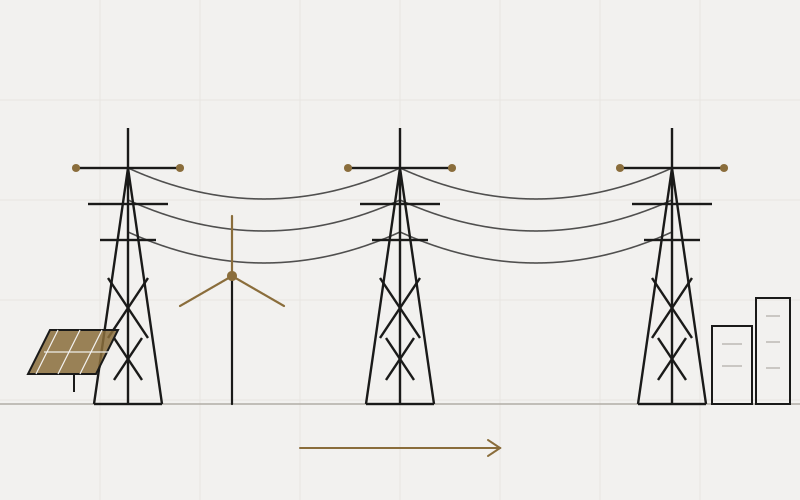
India's renewable energy sector has entered a new phase of growth. Over the past decade the country has expanded solar and wind capacity substantially, strengthening its position as one of the world's fastest-growing renewable markets. But as capacity rises, greater emphasis needs to fall on building an energy system that can efficiently transmit, store and deliver that electricity. Ratul Puri, Chairman of Hindustan Power, believes India's transition will depend on strengthening the complete power ecosystem.
Renewable energy growth must be supported by the infrastructure required to absorb and deliver power efficiently. The focus has to move from capacity creation to effective power delivery.
Capacity Is Growing Faster Than the Network
India added more than 54 GW of renewable energy capacity between April 2025 and March 2026, reflecting strong momentum in clean energy deployment. During 2025-26, the country added 52,537 MW of generation capacity across all sources up to 31 January 2026, of which renewables accounted for 39,657 MW — including 34,955 MW of solar and 4,613 MW of wind.
Rapid capacity addition has also surfaced challenges around transmission availability, grid balancing and renewable utilisation. Growing instances of curtailment show that generation capacity alone cannot determine the success of the transition: without adequate networks and flexibility, a portion of the electricity generated may simply not reach consumers when it is available.
What Curtailment Is Costing
According to Ember data, India curtailed around 300 GWh of renewable energy in the first quarter of 2026 due to transmission constraints. Over a longer window, Ember's analysis found that 2.3 TWh of solar power was curtailed between May and December 2025, driven by the difficulty of managing increased daytime solar generation with limited grid flexibility. That volume of electricity could have supplied nearly 400,000 households for a year.
Renewable-rich states with high solar and wind potential need advanced transmission systems so that electricity generated in those regions can be moved efficiently to demand centres.
Capacity addition is a significant step forward, but the value of renewable energy depends on how effectively it can be integrated into the grid and delivered to consumers.
Transmission and Grid Flexibility
Solar and wind output varies with weather and time of day. Solar generation peaks during daylight hours, while electricity demand often climbs in the evening as solar output declines. Managing that mismatch requires a combination of stronger transmission networks, advanced forecasting systems, flexible generation resources and storage technologies working together.
Storage as a Critical Enabler
Battery Energy Storage Systems (BESS) will play a significant role in improving renewable integration, capturing surplus electricity during high generation and supplying it during periods of higher demand. For a country seeing rising consumption from industrial growth, transport electrification and expanding digital infrastructure, storage will be essential to maintaining grid stability. Alongside BESS, pumped hydro and other flexibility solutions will support the shift towards a more balanced power system.
As Ratul Puri puts it, renewable energy requires a complete ecosystem: transmission, storage and grid management solutions have to progress alongside generation capacity to create a reliable and efficient electricity system.
Connecting Generation to Consumption
The next phase of growth will involve connecting renewable generation with efficient transmission systems, advanced grid technologies and storage capability, so that renewable electricity generated across the country contributes effectively to meeting rising demand.
India's energy transition will be shaped by how effectively we connect generation, transmission, storage and consumption. A reliable power system will be the foundation for sustainable economic growth.
As renewable capacity continues to expand, grid readiness and efficient delivery become increasingly important — the goal being an ecosystem where every unit of renewable electricity generated can actually be used. Related reading: flexibility and reliability as the new paradigm and coal gasification as a bridge to energy security.
About Ratul Puri
Ratul Puri is the Chairman of Hindustan Power, an integrated power generation company with a strong presence in renewable and transitional energy generation. Over the years he has been involved in the development of large-scale energy infrastructure projects that support India's growing power requirements and its transition toward cleaner energy sources. Read more about Ratul Puri.