Flexibility and Reliability: The New Paradigm in India's Energy Transition
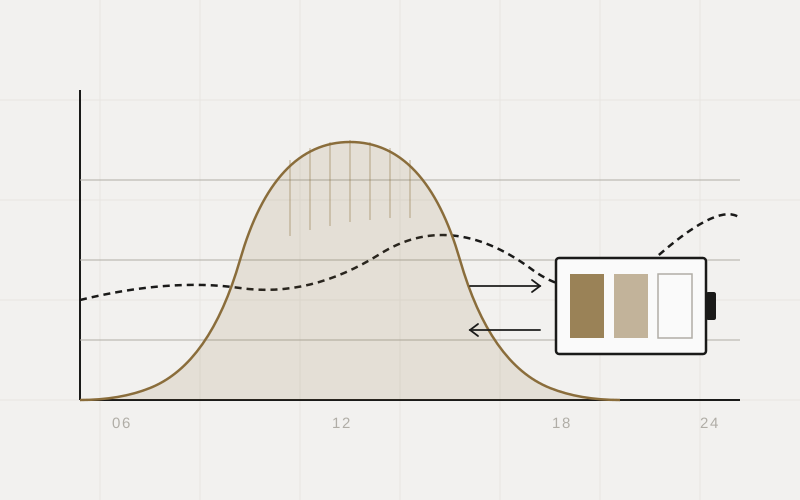
India's renewable energy sector is undergoing a quiet but significant transformation. The journey began with robust tariff auctions that made solar and other clean sources commercially competitive; record-breaking bids and rising investment brought renewables firmly into the mainstream. Writing in ETEnergyWorld, Ratul Puri, Chairman of Hindustan Power, argues that the next phase asks a harder question.
The focus is no longer limited to low-cost generation. The grid now requires reliable, dispatchable power that can support stable operations and consistently meet rising demand.
From Lowest Tariff to Lowest Systemic Cost
Historically, tariffs did not fully account for storage costs, transmission congestion, intermittency management, balancing requirements or curtailment risk. Storage-backed and hybrid renewable solutions may appear expensive upfront, but they reduce systemic stress and improve grid efficiency over time.
Traditional levelised cost of energy (LCOE) metrics fail to capture those hidden costs. The sector is therefore moving from a lowest-tariff framework to a lowest-systemic-cost approach — one that measures the total cost of delivering reliable power, including storage, balancing, transmission and integration. Procurement priorities are shifting accordingly, placing greater weight on capacity value, flexibility and reliability than on headline tariffs. This is what a maturing market adapting to a high-renewables system looks like, particularly as India advances towards its 2030 non-fossil capacity goals.
Reliability Becomes a Requirement
With deepening renewable penetration, the grid needs power that is dependable, dispatchable and available on demand. Hybrid solutions — solar-wind combinations integrated with battery storage — are increasingly preferred over standalone projects because they ensure availability during peak demand periods.
Flexibility, once managed implicitly, is now gaining formal recognition. Coal plants adjusted output, hydro balanced fluctuations, and system operators absorbed variability in real time; none of these services were explicitly valued or compensated. That is changing.
Storage at the Centre
Energy storage has become central to round-the-clock supply. Battery energy storage systems (BESS) and pumped hydro projects are critical to reducing variability, curbing curtailment and improving renewable utilisation. States need to prioritise new tenders for such projects while expediting land, water and regulatory approvals for storage-linked developments.
Central policy can accelerate this. Interstate transmission charge waivers for storage projects and the integration of storage into planning frameworks are essential, alongside grid modernisation through added transmission capacity, better demand forecasting and stronger grid management.
Grid Readiness Is the Bottleneck
Several states possess abundant renewable resources, yet inadequate transmission infrastructure routinely delays project execution. Addressing this requires proactive planning and commissioning of intrastate transmission networks aligned with both project timelines and central plans.
- Distribution upgrades — stronger lines, substations and transformers to evacuate renewable and distributed solar power while reducing congestion and losses.
- Ancillary service markets — expanded ramping reserves, frequency response and fast-response services to manage higher renewable shares.
- Demand-side flexibility — shifting consumption to match generation, rather than only the reverse.
A Global Pattern
India's transition is part of a broader global shift. In regions such as the European Union, high solar penetration has produced frequent zero or negative pricing during certain hours, revealing a misalignment between supply and demand. The response has been consistent everywhere: add storage capacity, strengthen balancing markets and promote demand-side flexibility.
As India advances towards energy security, ensuring flexibility and reliability will be just as critical as expanding renewable capacity. A balanced mix of conventional and renewable sources, supported by strong infrastructure and market mechanisms, will define the next phase of the country's energy transition — a theme Ratul Puri also develops in his article on reliable power delivery.