Ratul Puri on the Changing Landscape of India's Energy Future
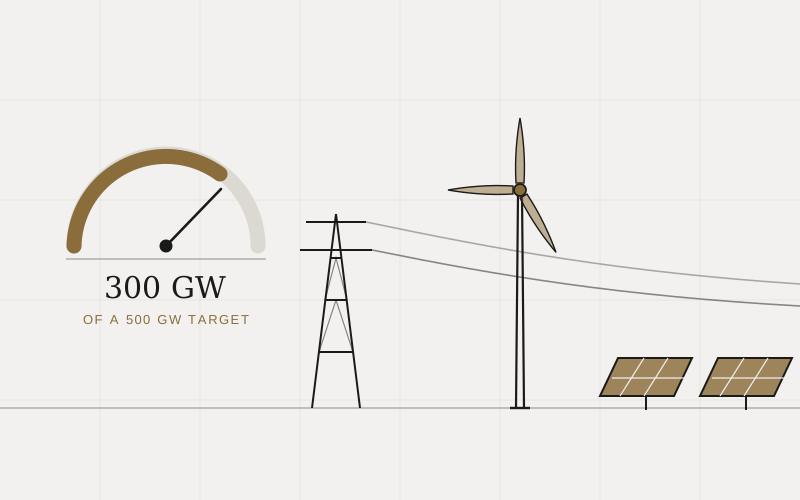
India's energy story is being rewritten by three forces at once: electricity demand that keeps climbing, industrial expansion that keeps deepening, and a clean-power build-out that has moved from aspiration to routine. The country has now passed 300 GW of installed non-fossil-fuel capacity — around 60% of the 500 GW target set for 2030. On that trajectory, the interesting question is no longer whether the capacity will arrive. It is how well it gets developed, integrated and put to work.
That is the framing Ratul Puri, Chairman of Hindustan Power, brings to the current moment.
Capacity figures alone will not decide the transition. What matters is how that capacity is built, connected and delivered into a growing economy.
Uttar Pradesh as the Test Case
Hindustan Power's 435 MWp — 300 MW — solar project in the Lalitpur district of Uttar Pradesh is a useful illustration of where India's requirements are heading. Won through competitive bidding in 2025 and among the largest solar developments in the state, the project has ₹1,135 crore of debt sanctioned by IREDA, has reached financial closure, and is under construction on schedule. Power will be sold to Uttar Pradesh Power Corporation Limited under a long-term power purchase agreement.
Uttar Pradesh matters here because it holds both sides of the equation. It is a state with fast-rising demand and a sharpening commitment to renewables, which means new clean capacity is not displacing a static load — it is racing one. Building generation close to that demand is how the two sides get reconciled without leaning harder on already-constrained transmission corridors.
From Capacity to Delivery
The emphasis on execution is deliberate. A project that is awarded but unfunded, funded but unbuilt, or built but unable to evacuate its output does not contribute to the transition in any way that a consumer would notice. What counts is dependable, efficient and sustainable generation that reaches load — which places construction discipline, grid interconnection and offtake certainty at the centre of the story rather than at its margins.
This is the same argument set out in more detail in Ratul Puri on renewable energy: the next phase will be reliable power delivery, and in his case for flexibility and reliability as the new paradigm — where the sector shifts from optimising for the lowest tariff to optimising for the lowest systemic cost, and where storage and grid readiness finally carry real value.
Beyond Generation
Large projects also register locally. Construction and operation of a plant at this scale supports regional economic activity and local employment, and adds industrial infrastructure in districts that have historically sat outside the main growth corridors. That regional dimension is part of why utility-scale renewables are treated as development infrastructure and not simply as energy assets — a theme running through Ratul Puri's writing on sustainable infrastructure.
Two Sides of the Same Equation
Rising demand and cleaner power are often presented as being in tension. The more accurate reading is that they are two sides of the same equation: an economy growing this quickly will need more electricity every year, and the only durable way to supply it is with generation that is affordable to run and defensible over decades. India's move past 300 GW of non-fossil capacity is evidence the equation can balance. Whether it keeps balancing depends on delivery — project by project, connection by connection.
For the broader arc of that transition, see Ratul Puri on India's renewable energy transition and the role of solar power in India's energy future.